
If you have ever spent an evening searching for ways to generate an income from your laptop, you have likely run into two extremes: flashy influencers claiming you can make $10,000 a week with “zero effort,” or overly complex guides that require a degree in computer science just to set up a landing page.
As someone who has spent years testing digital business models, building side hustles, and mentoring newcomers, let me give you the honest truth right upfront: learning how to make money online for beginners is completely achievable in 2026, but it is not a push-button miracle.
When I first started exploring online income ideas for beginners, I made almost every mistake in the book. I chased shiny objects, spent money on unnecessary tools, and fell for “get-rich-quick” promises that resulted in zero dollars and a lot of frustration. It was only when I treated online work like a real discipline—focusing on skill development, consistency, and delivering value—that things shifted.
The digital economy in 2026 is full of genuine opportunity. Artificial intelligence has lowered the barrier to entry for creative and technical tasks, global remote platforms are stronger than ever, and creator tools are accessible to anyone with an internet connection. However, success still requires time, focus, and a willingness to learn.
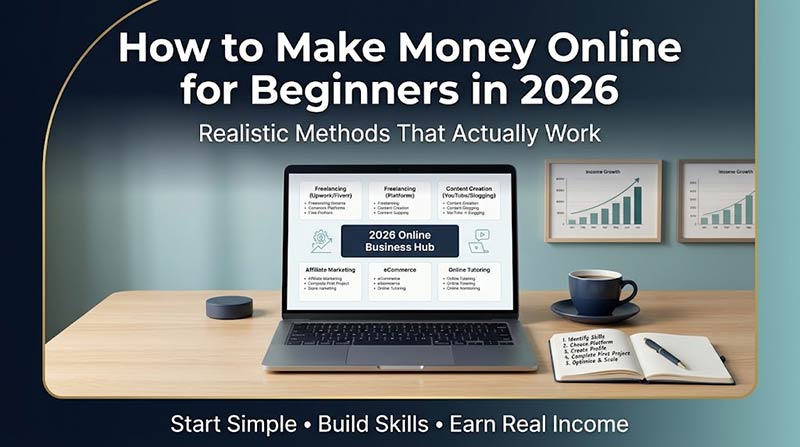
In this comprehensive guide, we will break down the best ways to make money online as a beginner in 2026. We will cover practical business models, realistic earning expectations, startup requirements, common pitfalls to avoid, and the exact steps you should take to earn your first dollar online.
1. Mindset and Preparation: Setting Yourself Up for Success
Before you pick a platform or register a domain name, you need to adjust your expectations. The biggest reason beginners fail to earn an income online isn’t a lack of opportunity—it’s a lack of patience.
The Realistic Timeline
Online income follows a compounding curve. In the beginning, you will likely put in a lot of effort for relatively small financial returns. Whether you are freelancing, launching a blog, or building an affiliate site, expect the first 30 to 90 days to be focused on learning, pitching, and laying groundwork.
Phase 1: Foundation (Months 1–2)  -> Skill acquisition, platform setup, zero-to-low earnings
Phase 2: Traction (Months 3–6)    -> First clients/sales, process optimization, modest earnings
Phase 3: Scaling (Months 6–12+)   -> Repeat clients, organic traffic, steady predictable growth
Essential Requirements to Get Started
You do not need a dedicated office space or thousands of dollars in capital to start. Here is the minimum viable setup:
- Reliable Internet & Laptop: While some microtasks can be completed on a mobile phone, any serious business model requires a computer.
- A Dedicated Workspace: A quiet area where you can focus for 1 to 2 hours of uninterrupted time each day.
- A Basic Financial Account: A bank account, along with a PayPal or Stripe account, to receive payouts globally.
- A Growth Mindset: A willingness to troubleshoot technical issues, accept rejection, and iterate on your approach.
2. Top Realistic Methods to Make Money Online in 2026
Let’s dive into the core business models that offer genuine pathways to build an online income for beginners 2026.
Method 1: Freelancing (Selling Existing Skills)
Freelancing is the fastest way to turn your existing abilities into immediate cashflow. Instead of waiting months for traffic or passive sales, you trade your skills directly for a fee from clients who need immediate help.
How It Works
Businesses and individuals constantly need freelance talent for copyediting, graphics design, virtual assistance, content writing, video editing, and software testing. You list your services on a marketplace or pitch clients directly, complete the work, and get paid upon delivery.
Popular Service Niches for Beginners
- Virtual Assistance (VA): Managing emails, scheduling appointments, customer service, and social media scheduling.
- Content Writing & Formatting: Writing blog articles, formatting newsletters, or proofreading web content.
- Short-Form Video Editing: Editing vertical videos (Reels, TikToks, Shorts) using accessible software like CapCut.
- Basic Web Design: Setting up simple WordPress or Shopify sites for local small businesses.
Startup Requirements & Cost
- Capital Needed: $0 – $50.
- Tools Required: Portfolio samples, a basic email address, and a profile on client platforms.
Realistic Earnings Potential
- Beginner: $15 – $25 per hour (or $50 – $200 per project).
- Intermediate (6–12 months): $30 – $60 per hour.
Mentor Tip for Success
Do not start by competing purely on price on massive job boards. Build 2 or 3 solid portfolio samples (even if created for fictional brands), and reach out directly to small business owners or content creators who clearly need help updating their content or managing their administrative tasks. For a detailed roadmap, check out our guide on how to land your first freelance client with zero experience.
Method 2: Affiliate Marketing
Affiliate marketing remains one of the most popular online income ideas for beginners because you do not have to create your own products, handle inventory, or manage customer support.
How It Works
You promote another company’s products or services using a unique trackable link (an affiliate link). When a user clicks your link and makes a purchase, you earn a commission on the sale.
[Your Content / Platform] ---> (Unique Affiliate Link) ---> [Merchant Website] ---> (Purchase Made) ---> [You Earn Commission]
Best Channels for Beginner Affiliates
- Niche Content Site / Blog: Writing product reviews, comparison articles, and “how-to” guides around a specific topic (e.g., home coffee brewing, outdoor camping gear).
- YouTube / Social Media: Reviewing products on video and placing affiliate links in the video description or bio.
- Email Newsletters: Sharing weekly recommendations and curated tools with an engaged subscriber base.
Startup Requirements & Cost
- Capital Needed: $35 – $100 (for web hosting and a domain name if building a site).
- Tools Required: Website builder (like WordPress), affiliate networks like Amazon Associates or Impact.
Realistic Earnings Potential
- Months 1–6: $0 – $100/month (building audience and content base).
- Months 6–12: $200 – $1,000+/month.
- Long-term: $2,000+ per month as traffic compounds.
Mentor Tip for Success
Avoid picking hyper-broad niches like “health” or “finance.” Instead, drill down into micro-niches—for instance, “ergonomic office equipment for home workers” or “vegan pet care.” Smaller niches are easier to rank for on search engines and allow you to build topical authority much faster.
Method 3: Selling Digital Products
Creating and selling digital assets is one of the best ways to build semi-passive income. You create the asset once, and you can sell it an infinite number of times without manufacturing costs.
Types of Digital Products Beginners Can Make
- Notion Templates: Productivity planners, habit trackers, or project management dashboards.
- Printable Worksheets & Planners: Meal planners, budget trackers, or educational activity sheets created on Canva.
- E-books & Guides: Short, actionable PDF guides solving a single specific problem.
- Design Assets: Social media templates, Lightroom presets, or stock photography.
How It Works
You host your digital files on platforms like Etsy, Gumroad, or Payhip. These platforms handle payment processing and automatically deliver the download link to the customer upon purchase.
Startup Requirements & Cost
- Capital Needed: $0 – $30.
- Tools Required: Free design platforms (Canva), store builder (Gumroad/Etsy).
Realistic Earnings Potential
- Beginner: $50 – $300 per month within the first few months.
- Established: $500 – $3,000+ per month once you have a catalog of products and steady traffic.
Mentor Tip for Success
Solve a single, immediate problem. A 10-page e-book that teaches someone “How to Setup a Home Audio Studio on a $200 Budget” will sell better than a vague 100-page book on “Music Production.” Learn more about this model in our complete article on creating and selling simple digital products on Etsy and Gumroad.
Method 4: Content Creation & Media (Blogging / YouTube / Newsletters)
If you enjoy sharing knowledge, teaching, or storytelling, building a content-based media business offers immense long-term value.
How It Works
You build an audience around a specific passion or industry topic by consistently publishing articles, videos, or newsletters. As your viewership grows, you monetize through ad networks, brand sponsorships, affiliate links, and memberships.
Popular Platforms
- Blogging (SEO-Focused): Publishing written content optimized for search engine queries.
- YouTube: Video content covering tutorials, reviews, video essays, or vlogs.
- Substack / Email Newsletters: Paid or ad-supported direct-to-inbox written publications.
Startup Requirements & Cost
- Capital Needed: $0 (YouTube/Substack) to $60/year (Self-hosted blog).
- Key Skill: Consistency, basic content formatting, and audience research.
Realistic Earnings Potential
- Months 1–6: $0 (Focus is strictly on content publishing).
- Months 6–12: $100 – $500/month.
- Year 2+: $1,000 – $5,000+/month.
Mentor Tip for Success
Content creation is a long game. Do not expect meaningful earnings in your first 90 days. Treat your first 30 blog posts or 20 videos as your “learning tax.” Focus on improving your titles, structure, and clarity with every upload.
Method 5: Microtasks and Online Testing (Quick cash, low scale)
If you need easy ways to earn money online immediately to prove to yourself that the digital economy is real, microtask and user testing platforms offer the lowest barrier to entry.
How It Works
Companies pay everyday consumers to test new websites, give feedback on user interfaces, transcribe short audio files, or perform basic data categorizations.
Popular Platforms
- User Testing: UserTesting, TryMyUI, Validately (Testing site navigation while speaking your thoughts out loud).
- Microtasks: Amazon Mechanical Turk, Remotasks, Clickworker.
Startup Requirements & Cost
- Capital Needed: $0.
- Requirements: Laptop, microphone, quiet room.
Realistic Earnings Potential
- Potential: $50 – $250 per month.
- Payouts: $10 per 20-minute website test.
Mentor Tip for Success
Treat microtasks as temporary stepping stones or extra spending money. They trade time directly for small payouts and do not build a scalable asset or high-value business. Use them to earn your first $50 online, then pivot your time toward freelancing or digital assets. Read our comparison of legitimate microtask sites vs. high-value side hustles to learn more.
3. Comparison of Beginner Online Income Methods
To help you decide where to direct your energy, here is a breakdown of how these business models compare across key parameters:
| Business Model | Startup Cost | Difficulty | Time to First $1 | Monthly Income Potential | Best For… |
| Freelancing | Low ($0–$50) | Moderate | Fast (1–3 weeks) | $500 – $5,000+ | People with clear existing skills (writing, admin, design) |
| Affiliate Marketing | Low ($35–$100) | Moderate | Medium (2–4 months) | $200 – $4,000+ | Content creators, bloggers, and reviewers |
| Digital Products | Very Low ($0–$30) | Low to Moderate | Medium (1–2 months) | $100 – $3,000+ | Creative individuals, organizers, designers |
| Blogging / YouTube | Low ($0–$60) | High | Slow (3–6 months) | $500 – $10,000+ | Patient storytellers, educators, and niche enthusiasts |
| Microtasks / Testing | None ($0) | Very Low | Immediate (1–7 days) | $50 – $200 | Anyone needing fast, extra spending money |
4. How to Choose the Right Method for You
Choosing the wrong model for your personality and schedule is a major reason people give up. Ask yourself these three simple questions to select your primary path:
1. How quickly do you need to earn money?
- Need money this month? Go with Freelancing or Microtasks.
- Building for 6 to 12 months out? Focus on Affiliate Marketing, Digital Products, or Blogging.
2. How much working capital do you have?
- $0 Budget: Start with Virtual Assistance freelancing, vertical video editing, or YouTube.
- $50 – $100 Budget: Purchase hosting for a niche blog or design digital product templates to sell on Etsy.
3. What is your natural strength?
- Organized and communicative? Virtual Assistance / Project Management.
- Enthusiastic about research? Niche Affiliate Marketing / Blogging.
- Creative or visually inclined? Graphic Design, Video Editing, Digital Downloads.
5. Common Mistakes Beginners Make (and How to Avoid Them)
Over the years, I have seen hundreds of enthusiastic beginners lose momentum due to predictable traps. Here is how you can bypass them:
Pitfall 1: Shiny Object Syndrome
Switching from affiliate marketing to dropshipping, then to freelance writing all within three weeks guarantees zero progress.
- Fix: Pick one business model and commit to it exclusively for at least 90 days before evaluating whether to switch.
Pitfall 2: Over-Investing in Tools Early
You do not need a $200/month CRM, a custom brand logo, or premium software tools before you have earned a single dollar.
- Fix: Use free tools (Google Docs, Canva, free tier email services) until client revenue justifies upgrading.
Pitfall 3: Ignoring Basic SEO and Search Intent
Publishing content or setting up store listings without checking what people are actually searching for leads to empty sites with zero traffic.
- Fix: Use free research tools like Google Trends or AnswerThePublic to find out what real users are actively seeking online.
Pitfall 4: Falling for “Passive Income” Myths
No income stream starts out 100% passive. Every “passive” system requires significant active upfront work, building systems, and initial creation.
- Fix: Accept that you must trade active sweat equity today to enjoy leverage tomorrow.
6. Recommended Essential Tools & Platforms for Beginners
To make your journey smoother, build your workspace around these reliable, beginner-friendly resources:
- Design & Content Creation: Canva (For graphics, social banners, and digital PDFs), CapCut (For short video editing).
- Productivity & Management: Notion (For organizing projects and tracking client outreach), Trello.
- Storefronts & Digital Sales: Gumroad, Etsy, Payhip.
- Freelance Marketplaces: Upwork, Fiverr, Contra (for portfolio creation).
- SEO & Keywords: Google Keyword Planner, Ahrefs Free Keyword Generator.
Taking Your First Step Today
Understanding how to make money online for beginners comes down to one core realization: the internet is simply a massive connection engine that pairs people who have problems with people who have solutions.
Whether you are writing an article for a client, recommending a helpful product through an affiliate link, or creating an organized planner that saves someone an hour of work, your online income will directly reflect the value you bring to others.
Your Action Plan for Today:
- Select ONE method from this guide that aligns with your timeline, budget, and skills.
- Set aside 60 minutes today to complete your account setup or create your first 2 portfolio samples.
- Commit to 30 days of consistent effort without judging your immediate results.
If you are ready to explore specific strategies in greater detail, explore our full library of step-by-step guides at makecash.top/side-hustles, where we break down platform tutorials, client pitch templates, and real case studies to help you build a reliable online income in 2026.

Disclaimer: This is for educational purposes only and not personalized financial advice. Past performance doesn’t guarantee future results. Always do your own research or seek professional guidance.