
Exchange-traded funds (ETFs) have revolutionized investing, making it accessible, affordable, and effective for everyday people who want to build long-term wealth without needing to pick individual stocks or time the market perfectly.
If you’re searching for how to start investing in ETFs, ETFs for beginners, or best ETFs to invest in for beginners, you’re in the right place. This step-by-step guide draws from my own journey as a long-term investor who started with modest savings and grew wealth primarily through low-cost ETFs.
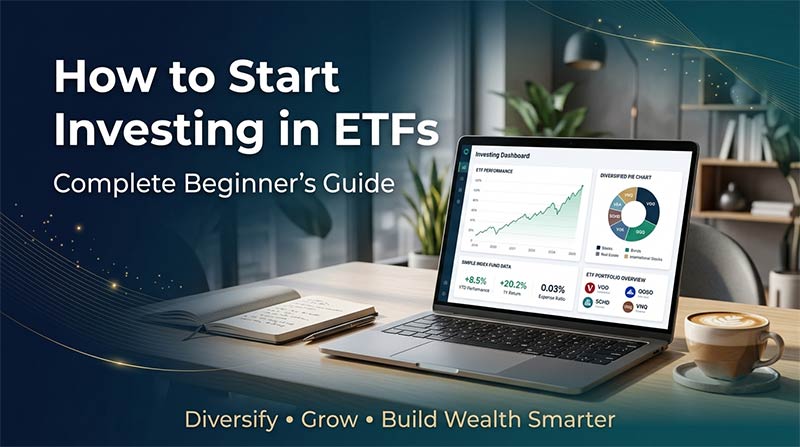
Why ETFs Are One of the Smartest Ways to Invest
ETFs are baskets of stocks, bonds, or other assets that trade on stock exchanges like individual shares. They offer instant diversification—owning hundreds or thousands of companies in one purchase—while keeping costs extremely low.
Key advantages for beginners:
- Low costs: Expense ratios often under 0.10%, far cheaper than most mutual funds or active management.
- Diversification: Reduces the risk of picking wrong individual stocks.
- Flexibility: Trade throughout the day with high liquidity.
- Tax efficiency: Especially compared to mutual funds, due to their unique structure.
- Strong historical performance: Broad market ETFs have delivered solid long-term returns (around 7-10% annualized after inflation for stock-heavy portfolios).
In recent years, even with market volatility, quality ETFs have continued to compound wealth effectively. I remember my first ETF investment—a simple S&P 500 tracker—back when I had just a few thousand dollars. I was nervous about market dips, but sticking with it through ups and downs taught me the power of patience and compounding. That early decision laid the foundation for my portfolio today.
In this guide, you’ll learn exactly how to invest in ETFs step by step: what they are, how to choose them, where to buy, building a portfolio, risk management, and proven strategies. Whether you’re starting with $100 or $10,000, the principles are the same.
Internal link: Not sure about the stock market basics? Check our guide on stock market basics for beginners at makecash.top.
What Are ETFs and Why Are They Ideal for Beginners?
An ETF (Exchange-Traded Fund) holds a collection of assets—stocks, bonds, commodities—and issues shares that investors can buy and sell. Most popular ones passively track an index, like the S&P 500.
Why ideal for beginners:
- You don’t need to analyze individual companies.
- Start small with fractional shares at many brokers.
- Automatic diversification across sectors and sizes.
- Transparent holdings updated daily.
From my experience, ETFs let you focus on life instead of constant monitoring. They’re “set it and mostly forget it” vehicles that still deliver market returns.
Different Types of ETFs
Understanding types helps you match investments to your goals.
- Broad Market / Index ETFs: Track major indexes (e.g., total stock market or S&P 500). Best core holdings for beginners.
- Bond ETFs: Provide stability and income (e.g., government or corporate bonds).
- Sector ETFs: Focus on one industry (tech, healthcare)—higher risk/reward.
- Thematic ETFs: Target trends like clean energy or AI.
- International / Global ETFs: Add exposure outside the U.S. for better diversification.
- Dividend / Income ETFs: Focus on high-yielding stocks for cash flow.
My perspective: Start simple with broad index ETFs. I keep most of my equity allocation in total market or S&P 500 funds and use smaller portions for international or bonds.
How to Choose the Right ETFs for Beginners
Focus on these criteria:
- Low expense ratio — Aim for under 0.10%. Every bit saved compounds massively.
- High assets under management (AUM) — Ensures liquidity.
- Tracking error — How closely it follows its index.
- Your goals and risk tolerance — Growth? Use stock-heavy. Stability? Add bonds.
- Diversification — Avoid over-concentration in one sector.
Practical tip: Use ETF screeners on brokerage platforms or sites like ETF.com. I always check holdings overlap to avoid redundancy.
Recommended beginner ETFs (as of recent data):
- VOO (Vanguard S&P 500 ETF): Low cost (0.03%), tracks top U.S. companies.
- VTI (Vanguard Total Stock Market ETF): Broader U.S. exposure.
- VT (Vanguard Total World Stock ETF): Global diversification.
- VXUS: International stocks.
- BND: Bonds for balance.
- SCHD: Dividend focus for income tilt.
These are battle-tested choices with strong track records.
Brokerage Comparison for ETF Investing
You need a brokerage account. Here’s a simple comparison of top options:
| Broker | Commissions (ETFs) | Key Strengths | Best For | Fractional Shares |
|---|---|---|---|---|
| Fidelity | $0 | Excellent tools, zero-fee funds | All-around beginners | Yes |
| Vanguard | $0 | Low-cost own ETFs, investor-owned | Long-term passive | Limited |
| Charles Schwab | $0 | Great research, thinkorswim | Research + trading | Yes |
All three are excellent with no account minimums for most accounts. I use a mix but started with Vanguard for its philosophy.
External link: For detailed broker reviews, see Broker comparisons.
Step-by-Step: How to Invest in ETFs
Step 1: Define Your Goals and Risk Tolerance
Are you saving for retirement, a house, or general wealth? Longer horizons allow more stock exposure. Assess risk—can you handle 20-30% drops?
Step 2: Open and Fund a Brokerage Account
Choose a broker, apply online (takes 10-15 minutes), link your bank, and deposit funds. Many support instant transfers.
Step 3: Research and Select ETFs
Use the broker’s tools. Start with 1-3 funds.
Step 4: Place Your First Trade
Search the ticker (e.g., VOO), choose market order for simplicity, enter amount or shares (use fractional if available), and confirm.
My lesson: I started small to build confidence. Automate contributions early.
Building a Simple Portfolio and Dollar-Cost Averaging (DCA)
A beginner portfolio example:
- 70-90% Stocks (e.g., 60% VTI/VOO + 10-20% VXUS)
- 10-30% Bonds (BND)
Adjust based on age/risk. A simple 60/40 or all-world (VT) works wonders.
Dollar-cost averaging: Invest fixed amounts regularly (e.g., monthly) regardless of price. It reduces the impact of volatility. This was key in my early years—I invested through market crashes and benefited from lower average costs.
Risk Management, Fees, Taxes, and Rebalancing
- Risks: Market volatility, inflation, sequence of returns. Never invest money you need soon.
- Fees: Minimize expense ratios and avoid unnecessary trading.
- Taxes: Use tax-advantaged accounts (IRA, 401(k)) first. ETFs are tax-efficient in taxable accounts due to low capital gains distributions.
- Rebalancing: Annually or when allocations drift >5-10%. Sell high, buy low automatically.
Warning: Past performance isn’t a guarantee. Diversify and stay patient.
Common Mistakes and How to Avoid Them
- Chasing hot sectors or performance → Stick to your plan.
- Over-trading → High costs and taxes.
- Ignoring fees → They eat returns.
- No emergency fund first → Invest only after basics.
- Lack of diversification → One ETF is fine to start, but global is better long-term.
- Emotional selling during dips → Time in the market beats timing.
From experience, the biggest win is consistency. I avoided panic-selling in downturns by reminding myself of historical recoveries.
Pros and Cons: ETFs vs. Individual Stocks
| Aspect | ETFs | Individual Stocks |
|---|---|---|
| Diversification | Excellent (built-in) | Poor (single company risk) |
| Time/Effort | Low | High (research needed) |
| Potential Returns | Market average | Higher upside (or total loss) |
| Costs | Very low expense ratio | No ongoing fees, but research time |
| Risk | Lower volatility | Much higher |
| Suitability | Beginners & passive investors | Experienced stock pickers |
ETFs win for most beginners. Individual stocks can supplement a core ETF portfolio later.
External link: Learn more about ETF basics at ETF.com.
Long-Term Strategies That Worked for Me
- Core-satellite: 80% broad ETFs, 20% thematic if desired.
- Lifecycle: More bonds as you age.
- Retirement focus: Maximize tax-advantaged accounts.
Internal links: Explore passive income ideas or retirement planning on our site.
Your Easiest Starting Steps
Starting with ETFs is straightforward:
- Open a brokerage account (Fidelity, Vanguard, or Schwab).
- Define goals and fund the account.
- Buy a low-cost broad ETF like VOO or VTI.
- Set up automatic monthly investments.
- Hold long-term and rebalance occasionally.
The most important factor is starting now and maintaining a long-term mindset. Markets will fluctuate, but quality ETFs have rewarded patient investors for decades.
Ready to take action? Open an account today and make your first investment—no matter how small. For more guides on building wealth, passive income, and smart money habits, visit makecash.top.
Investing isn’t about getting rich quick—it’s about making consistent, smart decisions that compound over time. You’ve got this. Happy investing!

•Most Trusted Broker — Asia 2026
•Broker of the Year — LATAM 2026
These awards confirm our commitment to building a rewarding trading environment and helping you uncover your potential. Thank you for choosing to trade with an award-winning broker!
Why choose MetaTrader 5 with Top Forex Brokers?
•Blazing-fast execution & enhanced stability
•38 built-in technical indicators & 21 timeframes for precision trading
•Optimized for all devices—desktop, mobile & web
•Trade a wide range of assets: Stocks, Commodities, Forex & more!
Disclaimer: This is educational content only, not financial advice. Past performance is not indicative of future results. Most retail traders lose money. Consult professionals and trade only what you can afford to lose.