
The commercial landscape in 2026 looks fundamentally different than it did just a few years ago. Carbon reporting standards have tightened globally, energy volatility remains a persistent line-item headache, and modern consumers—alongside B2B procurement officers—demand verifiable environmental accountability. Yet, most small to mid-sized enterprises (SMEs) lack the in-house expertise, bandwidth, or technical know-how to measure their environmental impact, let alone reduce it.
This widening gap between regulatory expectations and internal capability has created an unprecedented market opportunity. Independent eco-consulting helping businesses go green is no longer a niche service reserved for idealists; it is an essential business management discipline that sits squarely at the intersection of environmental stewardship and bottom-line profitability.
When I launched my sustainability consulting practice after years in corporate environmental management, I quickly realized that business owners rarely buy “sustainability” for its own sake. They buy risk reduction, operational efficiency, cost savings, compliance, and brand equity. The moment I shifted my positioning from “helping the planet” to “eliminating resource waste to expand profit margins,” my client conversion rates tripled.
Whether you are an experienced environmental scientist, a business strategist, or an entrepreneur looking to launch a high-impact advisory firm, this comprehensive guide will walk you through the core eco consulting services, strategic client acquisition, pricing structures, essential frameworks, and scaling methodologies required to build a thriving green consulting practice in 2026.
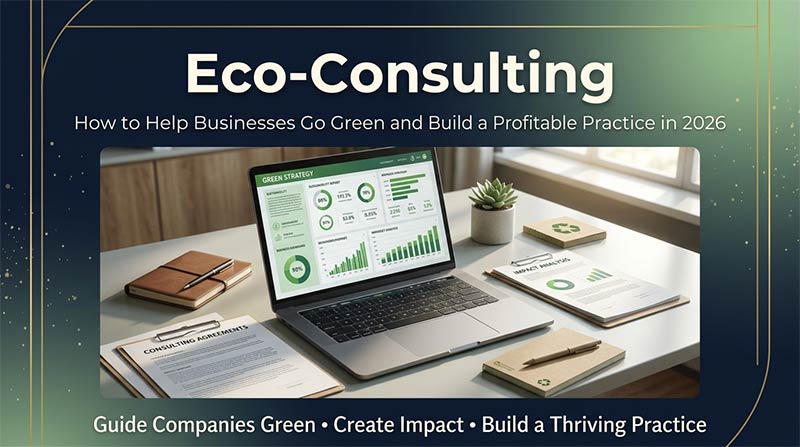
What is Eco-Consulting? Core Services Offered in 2026
Eco-consulting—often referred to as green business consulting or corporate sustainability advisory—is the practice of assessing a company’s operational footprint, identifying environmental inefficiencies, and implementing strategies that simultaneously reduce ecological impact and operational costs.
In 2026, modern green business consulting extends far beyond basic office recycling drives or swapping LED light bulbs. Clients require sophisticated, data-driven solutions across several key operational areas:
                      ┌────────────────────────────────────────┐
                      │    Core Eco-Consulting Deliverables    │
                      └───────────────────┬────────────────────┘
                                          │
       ┌──────────────────┬───────────────┼───────────────┬──────────────────┐
       ▼                  ▼               ▼               ▼                  ▼
┌──────────────┐   ┌─────────────┐  ┌───────────┐  ┌─────────────┐   ┌──────────────┐
│ GHG / Carbon │   │   Waste &   │  ┌ Circular  │  │ Regulatory  │   │ Sustainable  │
│  Accounting  │   │ Efficiency  │  │ Logistics │  │ Certificat'n│   │ Supply Chain │
└──────────────┘   └─────────────┘  └───────────┘  └─────────────┘   └──────────────┘
1. Carbon Footprint Audits & GHG Accounting
With international Scope 1, Scope 2, and Scope 3 greenhouse gas reporting standards becoming baseline requirements for major supply chains, companies need precise measurement. As a consultant, you measure direct emissions (combustion, fleet vehicles), indirect emissions from purchased electricity, and value-chain emissions (vendor activities, shipping, product end-of-life).
2. Operational Waste & Energy Audits
Energy and material waste represent literal cash thrown into the dumpster. Consultants perform detailed site assessments, thermal imaging inspections, and material flow analyses to identify energy leaks, excessive packaging, water inefficiency, and discarded materials that can be diverted, reused, or monetized.
3. Circular Economy & Sustainable Supply Chain Optimization
Clients increasingly demand assistance restructuring linear “take-make-waste” business models into circular loops. This includes vendor sustainability screening, sustainable packaging redesign, localized sourcing logistics, and establishing take-back programs for post-consumer products.
4. Green Business Certifications
Navigating certification frameworks can be overwhelming for business owners. Eco-consultants act as implementation managers for frameworks such as:
- B Corp Certification: Holistic evaluation of social and environmental performance.
- TRUE Zero Waste Certification: Diverting at least 90% of waste from landfills and incinerators.
- ISO 14001: Establishing formal Environmental Management Systems (EMS).
- LEED (Leadership in Energy and Environmental Design): Building and facility efficiency optimization.
5. Regulatory Compliance & ESG Reporting
Even mid-market businesses face pressures from retail partners and financial institutions to provide Environmental, Social, and Governance (ESG) metrics. Consultants draft formal sustainability reports aligned with frameworks like the Global Reporting Initiative (GRI) or the International Sustainability Standards Board (ISSB).
Identifying Your Ideal Clients: Who Needs Eco Consulting Services?
A common mistake made by new consultants is attempting to serve “all businesses that want to be green.” Broad targeting dilutes your value proposition and complicates your marketing. In my experience, the most lucrative opportunities for sustainability consulting for small businesses and mid-market firms fall into three distinct profiles:
                             Ideal Client Matrix
 ┌─────────────────────┬───────────────────────────┬────────────────────────────┐
 │ Client Type         │ Primary Motivation        │ Top Value Proposition      │
 ├─────────────────────┼───────────────────────────┼────────────────────────────┤
 │ Mid-Size Mfg & Log. │ Supply chain compliance   │ Retain enterprise contracts│
 │ Venture Startups    │ Investor ESG mandates     │ Higher valuation & capital │
 │ Local B2C Brands    │ Customer trust & loyalty  │ Brand premium & savings    │
 └─────────────────────┴───────────────────────────┴────────────────────────────┘
Niche A: Mid-Sized Manufacturing, Logistics, and Distribution ($5M–$50M Revenue)
- Why they hire you: Enterprise buyers (like Walmart, Target, or automotive OEMs) are enforcing strict Scope 3 vendor standards. If these mid-sized suppliers cannot provide verified emissions data, they risk losing major contracts.
- Your entry point: GHG accounting, vendor scorecards, facility energy reduction, and supply chain audits.
Niche B: Consumer Brands & Venture-Backed Startups
- Why they hire you: Modern consumers actively vote with their wallets. High-growth apparel, food and beverage, and personal care brands use sustainability credentials as a primary market differentiator. Venture capital firms also mandate ESG tracking prior to Series A/B funding rounds.
- Your entry point: Life Cycle Assessments (LCAs) for products, B Corp certification advisory, and eco-friendly packaging redesign.
Niche C: Local Commercial Services & Hospitality
- Why they hire you: Boutique hotels, craft breweries, restaurant groups, and commercial real estate firms face rising utility fees and local municipal waste mandates.
- Your entry point: Utility bill optimization, water conservation systems, local green business certifications, and zero-waste kitchen/event operations.
If you are exploring broader operational business models alongside consulting, review our guide on green business ideas to see how sustainable physical services interact with advisory roles.
How to Start an Eco Consulting Business: Skills, Credibility, and Certifications
You do not need a Ph.D. in Environmental Science to figure out how to start an eco consulting business, but you do need professional credibility, systematic problem-solving ability, and a strong understanding of commercial finance.
Core Competencies Required
- Data Analytics & Accounting: Proficiency in managing spreadsheets, processing utility consumption data, and calculating carbon conversion factors.
- Financial Literacy: The ability to calculate Return on Investment (ROI), Net Present Value (NPV), and Payback Periods for recommended sustainability retrofits.
- Change Management: Helping corporate teams adopt new operational habits and software systems without friction.
Top Professional Certifications for 2026
While hands-on project results always trump acronyms on a business card, acquiring recognized credentials significantly shortens sales cycles with risk-averse executives:
- ISSP-SA / ISSP-SEA: Offered by the International Society of Sustainability Professionals. Considered the gold standard for general sustainability practitioners.
- GHG Management Institute (GHGmi) Certifications: Essential if you plan to specialize in corporate carbon accounting and Scope 1–3 reporting.
- LEED Accredited Professional (LEED AP): Managed by the U.S. Green Building Council, this credential establishes instant authority in commercial real estate efficiency.
- TRUE Advisor: Offered by GBCI for consultants specializing in zero-waste certification and industrial waste diversion.
- B Corp Consultant Training: Administered through B Lab Global, equipping you to guide firms through the rigorous B Impact Assessment.
                      ┌─────────────────────────────────┐
                      │ Roadmap to Build Credibility   │
                      └────────────────┬────────────────┘
                                       │
      ┌────────────────────────────────┼────────────────────────────────┐
      ▼                                ▼                                ▼
┌─────────────┐                ┌───────────────┐                ┌───────────────┐
│ Earn 1 Core │                │ Audit 2 Local │                │ Publish Case  │
│ Credential  │───────────────►│ Non-Profits   │───────────────►│ Studies With  │
│ (e.g., ISSP)│                │ (Pro-Bono)    │                │ Real Metrics  │
└─────────────┘                └───────────────┘                └───────────────┘
Building Authority Without Decades of Experience
If you are transitioning from another field, launch your practice by offering two pro-bono or low-fee pilot audits for high-visibility local organizations (such as a regional food bank or a prominent local business). In exchange, require full access to operational data and a published video testimonial.
Documenting a real-world case study where you reduced a facility’s energy expenditure by 18% or diverted 5 tons of landfill waste builds more client trust than a wall of certificates.
Service Packages and Pricing Models
Pricing your eco consulting services correctly is the difference between struggling as a freelancer and scaling a lucrative consultancy. Avoid billing hourly whenever possible. Hourly billing penalizes your efficiency and shifts the client’s focus onto time spent rather than value delivered.
Recommended Pricing Frameworks
- Fixed-Price Project Bundles: Best for defined scopes like B Corp gap analyses, greenhouse gas inventories, or initial facility waste audits.
- Monthly Advisory Retainers: Ideal for acting as an outsourced “Chief Sustainability Officer” (CSO) for SMEs that cannot afford a full-time executive salary ($150,000+).
- Value-Based / Gainshare Pricing: Structuring your fee as a percentage (e.g., 20–30%) of verified utility or waste cost savings over a 12-to-24-month period. Highly attractive to conservative business owners because it carries zero upfront risk.
2026 Eco-Consulting Package Matrix
The following table outlines standard package configurations, market rates, and typical client outcomes used across the industry:
| Service Package | Target Client Profile | Core Scope & Deliverables | Pricing Range (USD) | Typical Client ROI / Value |
|---|---|---|---|---|
| Green Business Jumpstart Audit | Small Retail, Restaurants, Professional Offices | Site inspection, utility bill analysis, quick-win action plan, local green certification filing. | $2,500 – $5,000 (One-time) | 10–20% reduction in annual utility/waste fees within 6 months. |
| Carbon Footprint & Scope 1–3 Baseline | Mid-Sized Manufacturers, Distributors, Tech Platforms | GHG Protocol-aligned carbon accounting, Scope 1–3 calculation, executive dashboard, reduction targets. | $8,000 – $22,000 (Per assessment) | Unlocks procurement eligibility for major enterprise contracts. |
| B Corp Certification Acceleration | High-Growth Consumer Brands, Tech Startups | Complete B Impact Assessment guidance, policy drafting, legal alignment, audit prep, and filing. | $12,000 – $30,000 (Project-based) | 15–30% increase in brand equity valuation; improved talent retention. |
| Fractional Sustainability Officer (CSO) | $10M–$50M Mid-Market Enterprises | Ongoing monthly ESG tracking, vendor audits, staff training, regulatory compliance, quarterly reporting. | $3,500 – $8,500 (Monthly retainer) | Continuous compliance, automated carbon tracking, zero internal hiring overhead. |
| Zero-Waste Facility Redesign | Manufacturing Plants, Food Processors, Warehouse Operations | Material flow analysis, dumpster audits, vendor renegotiation, waste diversion systems, TRUE filing. | $10,000 + 25% of verified waste savings | $15,000–$80,000+ direct annual savings on haulage fees and raw materials. |
For professionals transitioning into advisory roles while maintaining secondary income streams, read our analysis on high-margin consulting side hustles for additional structuring options.
Marketing and Client Acquisition for Green Business Consulting in 2026
Landing steady clients requires a healthy mix of direct outreach, localized strategic partnerships, and inbound content marketing.
                   ┌─────────────────────────────────────────┐
                   │ Modern Client Acquisition Ecosystem     │
                   └────────────────────┬────────────────────┘
                                        │
         ┌──────────────────────────────┼──────────────────────────────┐
         ▼                              ▼                              ▼
┌─────────────────┐            ┌──────────────────┐           ┌─────────────────┐
│ Outbound Audits │            │ Strategic B2B    │           │ Thought         │
│ "3 Utility Leaks│            │ Partnerships     │           │ Leadership      │
│  I Found" Email │            │ (CPA / Insurance)│           │ Case Breakdown  │
└─────────────────┘            └──────────────────┘           └─────────────────┘
1. The “Green Opportunity” Outbound Audit Method
Instead of sending generic sales messages on LinkedIn, conduct 10 minutes of upfront research on a target prospective business:
- Review their website, public waste management disclosures, or job postings.
- Send a highly personalized video audit highlighting two visible operational inefficiencies or supply chain compliance risks they are likely facing.
- Offer a complimentary 20-minute “Opportunity Mapping Call” to review the metrics.
2. Strategic Referral Networks
Form formal strategic alliance partnerships with professionals who already have the trust of your ideal clients:
- Commercial Insurance Brokers: Sustainability retrofits (like upgraded electrical systems or flood-resilient infrastructure) lower business risk premiums.
- CPAs and Accounting Firms: Accountants frequently see rising utility overhead on balance sheets but lack the technical expertise to fix it.
- Commercial Real Estate Brokers: Property managers need sustainability credentials to attract high-value tenants.
Offer these referral partners a 10% cross-referral fee or reciprocal client introductions.
3. Localized Authority and Content Marketing
Publish monthly breakdown analyses on LinkedIn or your firm’s site dissecting recent regional environmental legislation, energy grid price adjustments, or industry specific compliance mandates.
Business executives actively search for clarity when new regulations pass; providing actionable explanations positions your firm as the premier local advisory group.
Key Frameworks, Software, and Tools Consultants Use
To deliver high-value results without spending hundreds of hours on manual data entry, modern eco-consultants rely on established global frameworks and specialized software tools.
                          Consultant Tool Architecture
 ┌──────────────────────┬─────────────────────────────┬───────────────────────────┐
 │ Layer                │ Standard Frameworks         │ Software Platforms        │
 ├──────────────────────┼─────────────────────────────┼───────────────────────────┤
 │ Carbon & Climate     │ GHG Protocol, SBTi          │ Watershed, Persefoni      │
 │ General Operations   │ ISO 14001, GRI Standards    │ Sustainability Cloud      │
 │ Lifecycle / Product  │ ISO 14040/14044             │ SimaPro, OpenLCA          │
 └──────────────────────┴─────────────────────────────┴───────────────────────────┘
Accounting & Calculation Frameworks
- GHG Protocol Standards: The global standard for measuring greenhouse gas emissions across Scope 1, Scope 2, and Scope 3 categories.
- Science Based Targets initiative (SBTi): Used to set clearly defined emissions reduction pathways aligned with the Paris Agreement goals.
- GRI Standards: The widely adopted framework for public corporate sustainability and ESG reporting.
Essential Software Stack
- Emissions Accounting Software: Cloud-based platforms like Watershed, Persefoni, or Sweep streamline carbon data collection across complex supply chains.
- Facility Energy Management: Tools like US EPA Energy Star Portfolio Manager enable free benchmarking of commercial building energy and water consumption against regional peers.
- Life Cycle Assessment (LCA): SimaPro or OpenLCA allow you to evaluate the holistic environmental impact of a physical product from raw material extraction to final disposal.
Overcoming Common Industry Challenges
Building an eco-consulting practice is not without its hurdles. Understanding how to navigate common client objections ensures long-term firm stability.
Challenge 1: “We don’t have the budget for sustainability right now.”
- Solution: Reframe the entire conversation around cost reduction. Lead with waste and energy audits that yield immediate, self-funding savings. Show how saving $30,000 annually on energy is functionally equivalent to adding $300,000 in top-line sales revenue (assuming a 10% net margin).
Challenge 2: Client Fears of “Greenwashing” Accusations
- Solution: In 2026, regulatory bodies strictly penalize unsubstantiated environmental claims. Teach clients to implement radical transparency. Advise them to publish precise data, acknowledge areas needing improvement, and utilize recognized third-party verifications rather than vague marketing fluff like “eco-friendly” or “all-natural.”
Challenge 3: Scope Creep During Audits
- Solution: Maintain explicit Statements of Work (SOWs). Clearly separate carbon baseline measurement from active implementation or policy drafting. Offer implementation as a secondary retainer once the initial diagnostic phase is completed.
Scaling Your Eco-Consulting Practice
Once your solo consulting firm reaches capacity (typically around $15,000–$25,000 in monthly revenue), you face a choice: stay a solo practitioner or scale into a specialized agency.
                   ┌──────────────────────────────────────────┐
                   │    Scaling Pathways for Your Practice    │
                   └────────────────────┬─────────────────────┘
                                        │
         ┌──────────────────────────────┼──────────────────────────────┐
         ▼                              ▼                              ▼
┌──────────────────┐           ┌──────────────────┐           ┌──────────────────┐
│ Productize       │           │ Subcontract      │           │ Develop SaaS /   │
│ Deliverables     │           │ Technical Experts│           │ Audit Toolkits   │
│ (Standard SOWs)  │           │ (Engineers/LCAs) │           │ (Recurring Rev.) │
└──────────────────┘           └──────────────────┘           └──────────────────┘
1. Productizing Services
Standardize your audit procedures into strict, repeatable blueprints. Create intake form templates, standardized data request sheets, and pre-formatted executive presentation decks so every client project does not require reinventing the wheel.
2. Building a Network of Subcontractors
Instead of hiring full-time employees immediately, establish relationships with freelance specialists:
- Certified Energy Auditors (CEMs) for technical building systems.
- Lifecycle Assessment (LCA) data modellers.
- Graphic designers for executive-ready ESG report publishing.
This allows your core agency to maintain high profit margins while taking on enterprise-level contracts.
3. Launching Digital Toolkits and Courses
Offer self-guided digital implementation templates, low-cost training programs for client staff, and small business audit toolkits. This creates recurring digital income while building a pipeline of warm leads for your high-ticket consulting packages.
If you are evaluating different corporate structures while expanding your operations, review our deep dives into scalable business guides to select the right business model.
Building a Purpose-Driven, High-Margin Practice
The demand for expert green business consulting in 2026 is driven by permanent shifts in global supply chain mandates, consumer preferences, legal regulations, and resource economics. Business owners do not need vague advice about environmental ethics—they need structured, analytical guidance that improves operational efficiency while lowering ecological impact.
By choosing a defined market niche, mastering core accounting frameworks, offering structured high-value packages, and positioning your service as an investment in profit protection, you can build a highly lucrative, recurring advisory firm that creates measurable positive impact for the planet.
To launch your firm systematically:
- Select a specific target market niche this week.
- Complete one foundational credential (e.g., ISSP, TRUE, or GHG Protocol training).
- Conduct two pro-bono opportunity audits to generate high-converting local case studies.
- Launch your core service packaging and start reaching out to referral partners.
Recommended Next Steps & Resources
- Explore actionable frameworks on our Consulting Side Hustles Guide.
- Compare profitable corporate models in our Green Business Ideas Directory.
- Learn step-by-step corporate registration strategies with our Small Business Planning Guides.

Disclaimer: This is for educational purposes only and not personalized financial advice. Past performance doesn’t guarantee future results. Always do your own research or seek professional guidance.