
The demand for skilled DJs has never been higher. Weddings, corporate events, private parties, rooftop clubs, and backyard celebrations all need someone who can read a room and keep energy high from the first track to the last. In 2026, more people are treating DJing as a serious side hustle—flexible hours, solid hourly rates, and the chance to turn a passion into consistent extra income.
I’ve spent years playing everything from intimate 50-person dinners to 400-guest weddings and late-night club sets. The money is real if you treat it like a business. A solid weekend can bring in more than many full-time side gigs, and the best part is you control your schedule. What really works for me is combining reliable gear, smart playlist building, and simple marketing that actually gets bookings.
This guide covers the practical side of starting and growing a DJ side hustle in 2026. You’ll get clear advice on DJ equipment for beginners and intermediate players, how to build playlists that keep crowds moving, preparing for different types of gigs, pricing, contracts, marketing, and the mistakes that cost new DJs money and reputation. Whether you’re just looking at controllers or already playing house parties, the goal is actionable steps you can use right away.
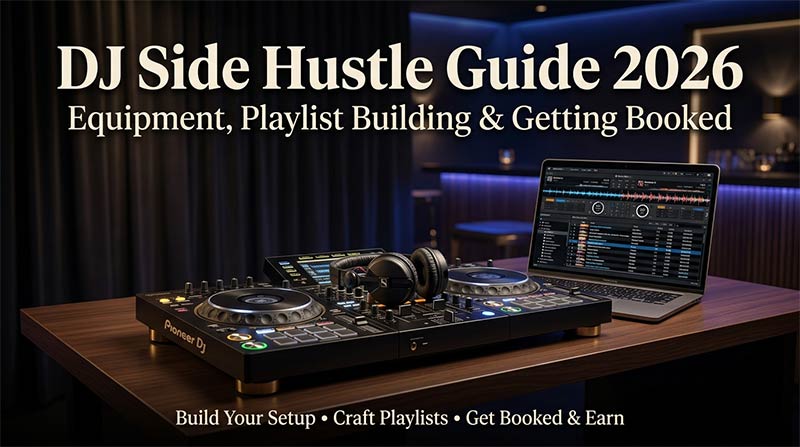
Essential DJ Equipment for Beginners and Intermediate Levels
You don’t need a full club booth to start. Most successful side-hustle DJs begin with a portable, reliable setup that travels well and sounds professional.
Controllers A good all-in-one controller is the fastest way in. Look for models with built-in sound cards, responsive jog wheels, and enough pads for hot cues and samples. Popular reliable options in the current market include Pioneer DJ DDJ-FLX series and similar mid-range controllers from Numark and Reloop. These handle most wedding and private party work without needing external gear. For intermediate players who want more control, stepping up to a four-channel controller or a modular setup with a separate mixer gives better flexibility for club-style mixing.
Mixers If you prefer decks or want to future-proof, a standalone mixer paired with media players or turntables is the classic route. Two-channel mixers work fine for most side gigs; four-channel units become useful once you’re regularly playing longer sets or working with other DJs.
Speakers and Amplification Never rely on venue speakers alone. A pair of active (powered) speakers in the 10–15 inch range covers most rooms up to 150–200 people. For larger events I bring a third speaker or a subwoofer. Clarity and volume without distortion matter more than raw wattage. Portable PA systems with Bluetooth backup can save a night when cables fail.
Headphones Closed-back headphones with good isolation are non-negotiable. You need to cue tracks cleanly even when the room is loud. Comfort for long sets is equally important—cheap headphones cause fatigue fast.
Software Serato DJ, Rekordbox, and Virtual DJ remain the main players. Most controllers come with licenses or free versions that are fully usable. Choose software based on the controller you buy and stick with it long enough to develop muscle memory. Cloud libraries and offline mode are essential for outdoor or remote venues with weak internet.
Accessories That Actually Matter Extra USB drives with backups of every playlist, high-quality XLR and RCA cables, a small power conditioner or UPS, and a sturdy laptop stand. A simple flight case or padded backpack protects gear during transport. In my gigs, the nights that go sideways are almost always cable or power related—not the controller itself.
How to Choose the Right Gear Based on Budget and Gig Type
Match the kit to the work you actually want.
Budget under $800–1,000 Start with an entry-level two-channel controller, decent closed-back headphones, and a pair of compact active speakers. This setup handles house parties, small private events, and practice. You can upgrade speakers later when bookings increase.
Mid-range $1,500–3,000 A solid four-channel or feature-rich controller, better speakers with a sub, professional headphones, and a spare laptop or tablet. This covers most weddings and corporate parties. The extra channels and effects make it easier to blend genres smoothly.
Higher end / multi-gig ready Separate mixer + media players or high-end controller, larger speakers, wireless options for certain venues, and redundant power and audio paths. Useful once you’re regularly doing larger weddings or club nights.
Gig type influences choices heavily. Weddings and corporate events reward reliability and clean, controlled sound over flashy effects. Club and late-night parties benefit from more effects, better low-end, and the ability to play longer continuous mixes. Outdoor events need weather-resistant cases and extra power planning.
I always test new gear at home and at one low-stakes gig before relying on it for paid work. What really works for me is keeping one proven “wedding kit” and a lighter “party kit” so packing is fast and stress is low.
Equipment Comparison by Budget Level
| Budget Level | Controller / Core Setup | Speakers | Headphones & Software | Best For | Approximate Total |
|---|---|---|---|---|---|
| Starter ($600–1,000) | 2-channel all-in-one controller | Compact active pair | Closed-back + free/lite software | House parties, small events | $700–1,100 |
| Intermediate ($1,500–2,500) | Feature-rich 2- or 4-channel controller | 10–12″ active + optional sub | Pro closed-back + full software license | Weddings, corporate, mid-size parties | $1,800–2,800 |
| Pro Side-Hustle ($3,000+) | High-end controller or mixer + players | Larger actives + sub + backup | Dual headphones + cloud library setup | Large weddings, clubs, multi-room | $3,500–6,000+ |
Prices fluctuate, so check current reviews and packages. Focus on reliability over the newest features.
Building Effective Playlists and Reading the Crowd
Playlist building is where most new DJs either shine or fall flat. A great set is not a fixed list of songs—it’s a flexible structure with prepared options.
Start with a core library organized by energy, genre, and era. I keep folders for warm-up, peak, cool-down, and “wild cards.” Tag tracks heavily: BPM, key (if you mix harmonically), and vibe notes. Software tools make this fast once you build the habit.
How to build a DJ playlist that works
- Research the crowd and event. Age range, cultural background, and any must-play or do-not-play requests matter more than your personal taste.
- Create a backbone of 60–80 reliable tracks that fit the expected energy curve.
- Add 30–50 flexible options so you can pivot.
- Prepare short “transition packs”—three or four tracks that move smoothly between styles.
- Always have clean edits or radio versions ready for family-friendly events.
Reading the crowd is a skill that improves with every gig. Watch the dance floor, not just the people near the booth. Empty floor after a high-energy track usually means the energy jump was too sudden. Couples leaving or phones coming out can signal it’s time to shift. In my experience, the best sets feel like a conversation—you lead, but you also listen.
For weddings I prepare three main playlists: cocktail hour (background, conversation-friendly), dinner (easy listening with occasional peaks), and dance floor (structured build). Clubs get longer continuous mixes with fewer hard stops. Corporate events often need more spoken-word friendly levels and branded music moments.
Keep playlists updated. Trends move fast; what worked last summer may feel dated. I refresh core lists every few months and always ask clients for a short “must-play / never-play” list in advance.
Preparing for Different Types of Gigs
Each event type has its own rhythm and expectations.
Weddings These are the bread-and-butter of many side hustles. Arrive early, coordinate with the planner or couple, and have clear timelines for first dance, parent dances, and cake cutting. Volume control is critical during speeches and dinner. Have backup plans for outdoor weather and power. Clients remember professionalism more than perfect mixing.
Clubs and Late-Night Parties Longer sets, higher energy, and more freedom with track selection. Focus on seamless transitions and reading the peak hours. Gear needs to handle sustained high volume without overheating or cutting out.
Corporate Events Often more formal. Background music during networking, higher volume for dancing later. Branding and clean presentation matter. Keep the setlist safer and be ready for last-minute schedule changes.
Private Parties and House Events These can be the most fun and the most unpredictable. Space is often tight, power may be limited, and the host’s playlist requests can be strong. A compact, good-sounding setup wins here.
Preparation checklist I use:
- Confirm venue details, power availability, and load-in time
- Send a short tech rider or gear list
- Backup every playlist on two USBs and the cloud
- Pack spares (cables, fuses, headphones)
- Review client notes the night before
Marketing Yourself and Getting Booked
Gear and playlists only matter if people hire you. Most of my early bookings came from three simple channels: personal network, a clean online presence, and consistent follow-up.
Create a simple website or strong social profile with short video clips of actual sets (even phone footage of a busy dance floor works). List the types of events you do, your coverage area, and a clear way to inquire. Google Business Profile helps local searches.
Ask every satisfied client for a short testimonial and permission to share photos or clips. Referrals from planners, venues, and past clients remain the highest-converting source. Partner with photographers, florists, and event coordinators—they often get asked for DJ recommendations.
In 2026, short-form video of crowd reactions still outperforms long technical demos for attracting clients. Show the result, not just the gear.
Pricing Strategies and Contracts
Underpricing is one of the fastest ways to burn out. Research local rates for similar experience levels. Charge for package value: hours, travel, setup/teardown, and any extras (uplighting, extra speakers, MC services).
Common structure: base package for a set number of hours + overtime rate + travel fee beyond a certain radius. Require a non-refundable deposit (usually 25–50%) to hold the date. Written contracts protect both sides—cover cancellation terms, overtime, power requirements, and what happens if equipment fails.
I learned early to put everything in writing. A friendly handshake is nice; a clear contract prevents most headaches.
Common Beginner Mistakes and How to Avoid Them
- Buying the cheapest gear and discovering it fails on the first paid gig. Test everything.
- Overloading the first hour with peak-energy tracks. Build gradually.
- Ignoring the client’s must-play list or cultural preferences.
- Showing up late or under-prepared for load-in.
- Playing only what you like instead of what the room needs.
- Skipping backups. One dead USB can end a night.
- No contract or unclear payment terms.
The DJs who last treat every gig as both a performance and a business transaction. Learn from the quiet nights as much as the packed dance floors.
Getting Started and Next Steps
Start small. Get a reliable basic setup, practice reading energy at free or low-stakes events, build a tight core playlist library, and put a simple professional presence online. Track every booking, every expense, and every lesson. Within a year of consistent effort many side-hustle DJs are turning away work or raising rates.
The combination of solid DJ equipment, thoughtful playlist building, and basic business habits is what turns weekend sets into real income. The demand is there—weddings, parties, and corporate events still need people who can make a room feel alive.
If you’re ready to explore more flexible ways to earn, check out additional side hustle ideas and event-service guides on makecash.top. You’ll find practical resources on creative businesses, pricing services, and growing local client bases.
The booth is waiting. Pack the right gear, build playlists that move people, show up prepared, and the bookings will follow. See you on the dance floor.

Disclaimer: This is for educational purposes only and not personalized financial advice. Past performance doesn’t guarantee future results. Always do your own research or seek professional guidance.