
Unity has quietly become one of the most powerful tools for turning a weekend coding experiment into a game that thousands of people download and play. What started as a simple engine for indie developers has powered everything from tiny mobile puzzlers to massive hits like Genshin Impact and Hollow Knight. If you’re sitting on an idea and wondering whether your hobby project can actually make it to the App Store (and beyond), the answer is yes — plenty of solo developers have done exactly that.
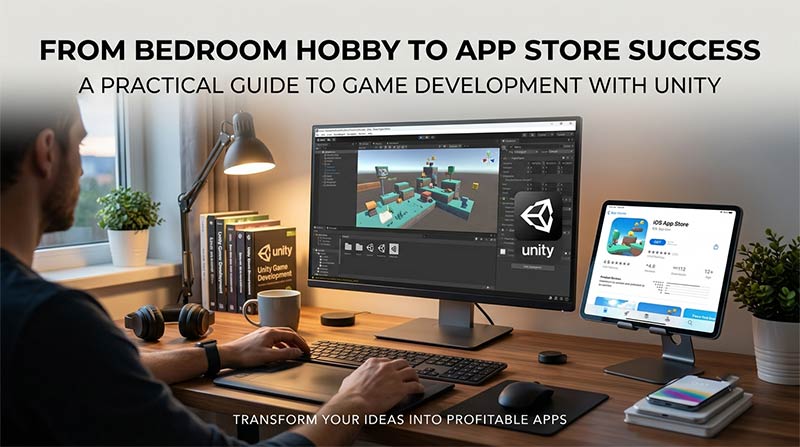
Why Unity Still Wins for Most Indie Developers
Unity strikes an excellent balance between accessibility and power. You can prototype a basic game in hours, yet scale it up to handle complex 3D worlds, multiplayer features, or high-end graphics when needed. The engine supports 2D and 3D equally well, runs on Windows, Mac, and even Linux for development, and exports to virtually every major platform: iOS, Android, PC, consoles, and web.
Compared to alternatives, Unity often feels like the pragmatic middle ground:
| Engine | Best For | Learning Curve | Cost for Indies | Platform Support |
|---|---|---|---|---|
| Unity | Mobile, indie, multi-platform | Moderate | Free tier generous | Excellent |
| Unreal | High-fidelity 3D | Steeper | Royalty after $1M | Excellent |
| Godot | Lightweight 2D/3D | Gentle | Completely free | Good |
For most hobbyists aiming at mobile success, Unity remains the sweet spot.
Getting Started Without Burning Out
Download Unity Hub from the official Unity website. Start with the latest LTS (Long Term Support) version for stability. The 2022 LTS or 2023 series are particularly solid for mobile games.
Focus on these first steps:
- Complete the official “Roll-a-Ball” or “2D Roguelike” tutorials in the Unity Learn platform.
- Pick a tiny, completable scope for your first project — think one mechanic, three levels, simple art.
- Use free assets from the Unity Asset Store to avoid getting stuck on art or sound early on.
Many successful developers admit their first game was ugly and simple. That’s fine. The goal is to ship something and learn the full pipeline: coding → polishing → testing → publishing.
Core Skills That Actually Matter
You don’t need to become a C# expert overnight. Start with:
- Scripting basics: Movement, collisions, UI, saving progress.
- Animator and Timeline for smooth character control and cutscenes.
- New Input System (much better than the old one).
- Addressables for efficient asset loading on mobile.
For mobile specifically, learn about performance: optimize draw calls, use occlusion culling when relevant, and test on real low-end devices early. The Unity Profiler is your best friend here.
Turning Your Game into Money on the App Store
Publishing to the App Store requires an Apple Developer account ($99/year) and careful preparation. Unity makes builds relatively painless with its iOS build support, but you’ll still need Xcode on a Mac for the final submission.
Key monetization paths that work in 2025-2026:
- Freemium with in-app purchases (coins, skins, remove ads)
- Rewarded video ads (via Unity Ads, Google AdMob, or ironSource)
- Premium one-time purchase for simpler games
- Hybrid models that many hits now use
Focus on retention first. A beautiful game that people play for three minutes won’t earn much. Implement daily rewards, progression systems, and social features (leaderboards via Dreamlo or GameCenter) to keep players coming back.
Real-World Examples and Lessons
Monument Valley and Alto’s Odyssey showed that polished, artistic experiences can succeed without being free-to-play grindfests. On the hyper-casual side, countless small studios have made solid income with simple mechanics that go viral through smart ASO (App Store Optimization) and user acquisition.
One lesson I’ve observed watching the indie scene: marketing matters as much as the game itself. Even a great Unity game can die in obscurity without decent screenshots, a trailer, and some presence on TikTok, Reddit, or itch.io.
My Take as Someone Who’s Watched This Space Closely
Unity’s biggest strength is also its trap: it makes starting too easy. Many beginners spend years jumping between shiny new tutorials instead of finishing games. The developers who succeed treat game dev like a craft — they ship imperfect versions, gather feedback, and iterate.
If I were starting again today, I’d:
- Build in public (Twitter/X or a simple devlog)
- Join communities like r/Unity3D, Unity Discord, or Indie Game Dev groups
- Set hard deadlines and use tools like Notion or Trello for scope control
- Learn basic marketing earlier rather than treating it as an afterthought
The barrier to entry has never been lower, but attention is scarce. A game that respects the player’s time and delivers a clear, satisfying loop still has a real shot.
Next Steps and Resources
- Unity Manual — always open in a tab
- Unity Learn — structured paths
- Apple’s App Store Review Guidelines
- Brackeys archives and newer creators for visual learning
- TestFlight for iOS beta testing
Game development with Unity rewards persistence more than raw talent. Your first game probably won’t be a breakout hit, but your third or fourth might be — especially if you actually finish the previous ones.
The tools are free, the knowledge is abundant, and the App Store is waiting. The only question left is whether you’ll ship.
Start small, stay consistent, and enjoy the process. The best indie success stories almost always begin exactly where you are right now: with an idea and a little free time.

Disclaimer: This is for educational purposes only and not personalized financial advice. Past performance doesn’t guarantee future results. Always do your own research or seek professional guidance.